Wednesday, January 29, 2014

Writing in Layers

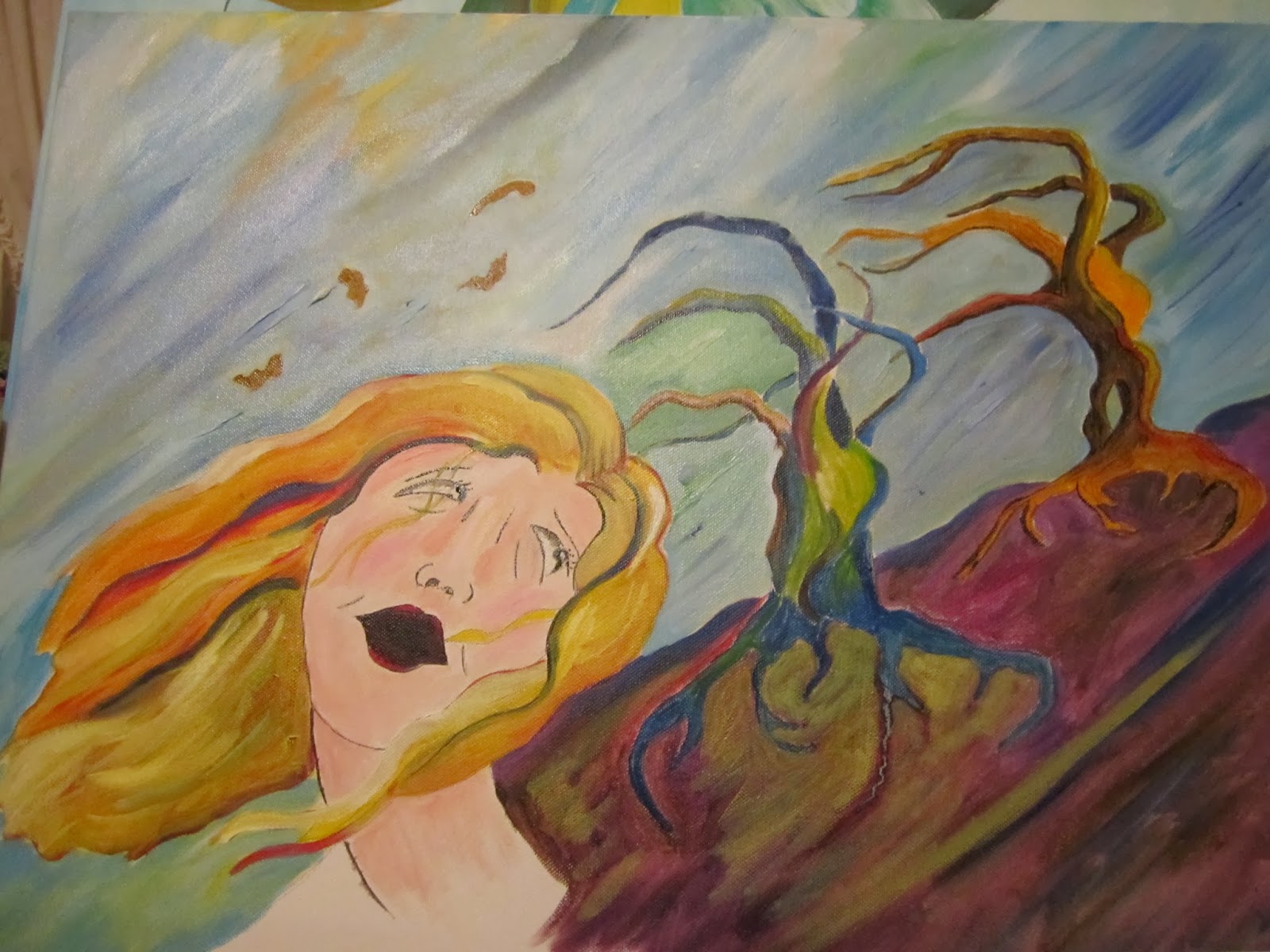
Exuberance in Blues      

 in acrylics and fabric  18" x 24"  (not finished, I'm just getting started here.)
When I paint, I do the entire canvas first with an undercoated background, let it dry, then go back over it with an enlarged drawing, adding lines, painting the composition, then finally adding details.  That's me painting in layers.  I also have the same tendency when I write.

And that tendency is to be a "meat and potatoes" writer.  I can tell you a great skeleton story: this is what happens, why it happens and this is how it ends - but that's not much of a story, is it?  The real story comes out in the details and the finesse in which it is told.  The reader wants to really be there in the story with real characters, not paper cut outs.  And the writer also needs to give his characters LIFE, with all its foibles.  Set the scene - hear the crunch of the dry grasses as they are walked upon, the feel of the hot breeze upon one's face.  Uncertainty and fear.  How does that physically feel?

Usually after I beat a story to death (by continually gong back over it ad nauseum, filling in more details each time), I quickly lose interest in it.  This is truly the "work" part of writing.  Don't let anyone fool you; writing - the constant editing and revising - is hard work, just as perspective, drawing and graphing is the work part of art.  Creativity carried out to its end is a lesson in perseverance and commitment.

Saturday, January 11, 2014

The Long Road

My father had been in the hospital during Thanksgiving with an infection and once released, was on home care.  I was trained by the nurses to change his IV bag, tubes, and to reset his digital pump daily.  Hence, the reason I've not been here for a while with managing two households.  I've been a little busy. But the six weeks are up today and we're all celebrating - my parents are especially since they've been practically housebound for that entire time.  But to be honest about it, I'm going to miss the drive from the southernmost end of Plain township to  Green.  every day.  I had a 20 minute drive - but I made it in 15 minutes on New Year's - no traffic! 

The 'back way' consisted of omitting Cleveland avenue in favor of Whipple North to Shuffel,  Where I ended up was Aultman Avenue, State Street, then Boston Avenue. I love Boston Avenue.  That's where the above picture was taken shortly before Christmas.  The flatness of the land around Boston is, for me, wonderfully reflective of the farmland where I once lived when I taught in Arkansas.  That's a different story. For someone whose has half her family coming from Ireland via West Virginia, it's a little ironic that I found solace in the flatness of the land, but there was a peacefulness about it.  I also found some introspection and inspiration. 

No doubt those seeds sown during this time will eventually find their way to the surface when the time is right.  Maybe they will appear in a painting or possibly a poem.  The possibilities are endless. 

Monday, December 9, 2013

Our First Christmas Tree


 This being the month of December, I should probably tell you a Christmas Story, albeit not a typical one.  This was written in 2007-ish when I first started at the writers' guild.  This is a story of a newlywed couple's first outing together to get their Christmas tree, complete with disastrous results.    In retrospect, I really should have taken a picture of every Christmas tree we've had since.  Some have filled half the living room
.  Think Clark Griswold's over-sized tree.  The tree in this picture is undersized and tame in relation to previous years.  I have to keep telling him "Less is More".  He never believes me.

                                Our First Christmas Tree
                                                                        1989
My husband, Mark, and I were still newlyweds when I became pregnant with our first child, and by December of that year I was four months pregnant and very noticeable.  One cold and wintry day a week before Christmas we traveled an hour away to a tree farm to buy our first Christmas tree.  I was so excited since this was going to be my first real tree and I was anticipating the traditions we would start as a family.  Because it was so late in the season there were many trees missing from the tree farm and a snow storm the previous day covered all the ruts and stumps that were in the field.  My mother-in-law, bless her heart, lent me the maternity coat she had worn with all her spring babies and I could hardly refuse her generous offer.  This coat was from the 1950’s, hung down to my ankles, and was a color that would soon come to be known as “harvest gold” on all 1970’s era appliances.  Together with the multi-colored scarf Mark had lovingly wound around my face, neck and head that day, I felt like an immigrant.

            As soon as we arrived at the tree farm I saw the perfect tree right in front of our parked car.

             “Right there, Mark, it’s gorgeous!” I excitedly shouted, “Get it!”.  He turned and gave me a look that I could only interpret as meaning “Are you kidding me?  We only just arrived.”   That would have been way too easy.  Mark wanted to search; he enjoyed the hunt, and walked joyfully through the rows, up the hills, and around the gullies with his tree saw, a rope, and a grin on his face.  He was reliving his childhood.  That left me to follow him, struggling with a large stomach, my head and face wrapped like a mummy, and a coat that hung down to my ankles in the freezing wind.  Because the snow was blowing hard and strong that day, every four or five steps saw me up to my knees in every root hole and gully on that property.

            I thanked God when Mark finally found his perfect tree. At that point I didn’t care what it looked like and I wasn’t going to argue about it.  I was pregnant, cranky, and tired from meandering all afternoon around that tree farm.  What I had anticipated as an idyllic afternoon turned into an out-of-body experience; I desperately wished I wasn’t there.

            The tree was cut and strapped to the top of the car and we left for the hour drive on the freeway not knowing that we had to cover the tree to protect it.    By the time we arrived home, our once green tree had turned dirty gray.   It was covered with road salt.

            “What happened?” I cried as I looked at the tree.  There was no way I was going to let Mark put that filthy gray tree in our apartment.  He had better do something and he’d better do it fast.  It was freezing outside.  I looked at my husband for a solution.  He felt the pressure.

             “I’m thinking” Mark said as he surveyed his prize.   He walked around the tree, let out a big sigh, then sent me into the apartment to thaw while he hosed the tree down in twenty-three degree weather.  How else was he going to clean it?  Unsurprisingly, the tree completely froze.  It stood there in shock, covered head to trunk with ice crystals, glittering in the last of the day’s light and softly tinkling like wind chimes in the biting wind.   The tree was glorious in the fading light. It was a shame we had to bring it in to the warmth after that. There was nothing to do but bring it in the kitchen, put papers under it, and leave it to melt.  And it did.  The tree snapped, crackled, and dripped all night long.

            As I sat on the couch listening to our first Christmas tree melting, I vowed never to cut another living tree.  I shook my head.  “I’m going  to survive this” I  silently told myself.  “Next year will be different”.   And indeed, it was.                                                                                                                                

Sunday, November 17, 2013

Seduced by a bad idea


Seduced by a Bad Idea


I didn’t see it coming

She snuck up from behind

Temptation so great

I was out of my mind.


She tapped on my shoulder

And tugged at my heart

I should have seen it coming:

bad news from the start.


Persistent, petite, and smiling,

She wouldn’t let it rest

And the way she talked

She made perfect sense.


She insisted that all would be well,

My decision I wouldn’t regret

I had to have been touched in the head

Indeed, this no one would soon forget.


She pushed all the right buttons

I should have declined

But she still seemed to be

a good idea at the time.


                                                                           Artist/Author's note: the drawing came first, with the title, then the  poem came to be.  This picture was taken out of my sketch book, and only now I'm considering painting this in oils.  I think I've decided I don't like acrylics since I'm more of a planner.

Sunday, November 3, 2013

The Sound of our Words

   Writers take pen in hand and write on paper - or they key their words on a computer screen.  Then the words are there in black and white right where they belong.  But sometimes we as writers forget the realm of words intersects our daily lives.  Words kept on paper alone lead a solitary existence when they are meant to be spoken and brought to life.

   Too often we focus on punctuation and the placement of periods in our writing - picayune stuff - when we need to focus on the life of the writing.  Two things jump out at me when thinking about this.

ONE: I was helping to judge a poetry contest this past summer and the main judge was (rightly) being critical of form and eliminating poetry that wasn't up to snuff.  At one point there was a disagreement about a piece of writing and I suggested that since the winning entry was to be read out loud that we read the final selections aloud and find out how they sounded when spoken. We forget sometimes that our ears will also judge.  What looks good on paper sometimes just doesn't make the grade when spoken.

TWO: I recently shared one of my more recent poems with a poet friend ( who absolutely adores her thesaurus) and being helpful, she suggested that since my poem was "ethereal" (her word, of course), I should substitute the word 'clothed' for 'attired'.  I thoughtfully considered that, but in the end decided to use the common word I originally had.  In my opinion, the spoken word 'attired' sounded too much like 'tired' and made me think 'worn out and exhausted'.  It also has a hard sound to it. Most often words with T's, D's and K's, when spoken, have harder sounds to them.  The softer sounding words have W's, H's, L's, TH's, R's, and SH's.

   When you look up a word in the thesaurus to make creative choices and substitute ordinary words (that we all use) for others, one must also need to consider the sound of those words when spoken.  I chose to stick with my softer sounding word choice 'clothed' because I felt it was a better fit.

                  Falling Gold

                 The North wind has come calling
                 Trees nod their acquiescence
                 Leaves bristle on Pointe
                Awaiting their dances.

               Caught up in the whirlwind
               Limbs bend and bow            
               Leaves rustle with the wind
               Needing to go.

              One by one
              For each whose time has come                                     
              To jump, dance and pirouette                     
              Under the setting sun.

              Clothed in gilded colors
              They tumble, turn, and fly
              Sparkling, glistening, filtering sunlight
              Dancing in the crisp blue sky.

             Winds buffet, trees billow
             Falling gold: amber skies
             Gathered by the whirlwind
             Dancing their last goodbyes.
                                                         ~Mela Saylor


Thursday, October 31, 2013

National Novel Writing Month


November is National Novel Writing Month, commonly called NaNoWriMo by its participants. This is a month dedicated to writing a novel – 50,000 words. As this is gearing up, thousands of writers are getting ready by laying out their stories in their heads and gathering reams of paper and ink for their computers.  And most of the women who are mothers and wives, are trying to get done what they can possibly do ahead of time. 

The premise of this is to get your entire story laid out in writing – just get everything that comes into your head on paper.  Editing is not allowed.  I believe March is when rewrites are encouraged.  The goal is to write 50k words in one month. That comes to around 1700 words a day. Not a problem if one is a prolific writer.  My inner editor is rebellious and she’s always on duty. More often than not I fight with her when I try to write. For every sentence I write, she wants to rewrite it. I often see my pen refusing to touch down on paper for fear of not using the right word, and auto-correcting when I do.  Is that a neurosis?

I attempted to do Nanowrimo several years ago.  I started our like gangbusters raking up leaves and throwing down words, but sadly, I didn’t make it past day two. Why? It was November, silly. Let’s see, two teenage boys, a yard filled with trees and a high-maintenance husband. What could go wrong?  I couldn’t delegate a darn thing.  And let’s not forget Thanksgiving also falls during this time frame. 

When I originally described this national event to a writer friend, she was silent trying to digest this new information. I could hear her thinking on the other end of the telephone. She finally spoke up “No editing allowed?”
“Nope – just continuous writing, getting everything out and on paper”
“so, what you’re telling me is they just want you to verbally ’throw up on paper’ that first month?
            “Pretty much.”
            “huh.”
            This must be a difficult concept for a precise writer. Her strong suit is Haiku, the short-hand of poetry. 

So this year I will attempt to do my own month of intense writing - and it won’t be around the holiday season.  I’m thinking either February or March when the winds are blowing and I’m relegated to staying inside the house and waiting out the cold weather on my couch for the first signs of Spring, the buds, the birds, and the blooms, to come around.

Thursday, October 24, 2013


I had been looking for this painting for a while - just to look at the colors.  This was painted in 1987 and is a whopping 24" x 36".

I've been 'stuck' for the last few months with a painting.  I like the design but I don't care for the colors I used - even though they were meant to be underpainting.  I've finally figured that my problem is that I've been trying to be someone I'm not - artistically speaking.  Plus I've been using acrylics.  I'm going back to oils. 

Tuesday, September 10, 2013

Illusions


Life is the greatest illusion
For what is heard and seen
Is nothing compared
To what remains unseen.

And as eternity rushes toward us
upon this spinning globe
there are forces at work around us
unheard, unseen, unknown.


Tuesday, August 20, 2013

This is what happens when I let the drawing I'm doing tell me where it wants to go. Some things have a mind of their own.  This was one of them.  It's called "Vessel". Oil on canvas, 18" x 24".

Friday, August 16, 2013

Wednesday, August 14, 2013

Swimming with Sharks


The Subjectivity of the arts


The Beholder

Art speaks to each one of us in different ways. When we view a painting, listen to music, or read something, how we perceive it, read into it, and what we take away from it depends on our background. It depends upon who we are. It is subjective.  And the reason it is subjective is because everyone has an opinion on it whether or not they know anything about it.

Subjective -vs. – Standards

One of the very first things I learned during my practice teaching was that one should have a very good reason for assigning letter grades to each student’s art assignment.  It was very easy to “eyeball” it as each paper was put into a category (stack on the floor) – “Wonderful” (A), “eh-Ok” (C), and “Yikes!” (D and under), but when that student asks me the day those were passed back why they received the grade they did, I couldn’t just say “Well, LOOK at it!” I needed to point out exactly where they went wrong, be it composition, center of interest, perspective, line, light source, and show them how it could be improved upon.

Subjective: Adj. placing excessive emphasis on one's own moods, attitudes, opinions, in relation, relative, in comparison.

If we use those words, then the next logical question is: Compared to what?  My college roommate and I were, in our own way, competitive. We were education majors, she in mathematics, I in art. One quarter we took the very same class with the same professor, only at different times of the day. At the end of the grading system we found that Rose, my roommate, was ahead by only a handful of points. But, since she was in a different class with a different group of students, her grade turned out to be a “B”.  I must have been in a dumb class, for I ended up with an “A”.  That is what grading on the curve does –it does away with absolute standards and there is no longer a “plumb line” for comparison.  What we are left with is each other to for comparison.  That is a slippery slope. We now have what we have in the arts.  

subjective = personal

Fact: no one ever takes up math or science as a hobby. Creating art can be personal and it makes us feel good to create something.  Note here that I didn’t say copy. The words create and copy mean two entirely different things. To create an image from the recesses of one’s mind is nothing short of magical. Art expresses who we are as individuals. Art is also used in therapy.  But we must also keep in mind that “therapy art” is not on par with a Chagall and perhaps it is best not to be displayed in public.

I believe the term artist has been used loosely in reference to Andy Warhol and Jackson Pollock.  I will admit that perhaps their contribution to art has been to open the publics eye to new concepts, perhaps even usher in a new era of art, but at the same time I ask, are the principles of art being suspended for them? Where is the composition, rhythm, movement? Please, someone, tell me where it is in the middle of that mess?  I’m referring to Pollock.  As my mother was often quoted as saying “a monkey could have done that”. Honestly, Pollock’s work looks like someone just threw paint all over the place.  To be kind, it’s a great START.  But a background does not make a painting.  I feel it’s just hoopla – another version of the Emperor’s New Clothes.
The principles of design still need to be there, but I can say that I do understand what Kandinsky was trying to do, having read his book “Point and Line to Plane”. Still, I may be simplistic in my view, but I feel there is something inherently wrong if an artist needs to write a book to explain their art work.

Why Artists Create

When I was in high school, the art teacher would begin every year with reading this list of “Why Artists Create”.  I’d like to end this blog with that list.

12.  To paint a pretty picture
11.. To make extra money by selling trite objects at craft shows.
10.. For decorating a room.
  9.  To get attention by shocking viewers.
  8.  To show their skill in duplicating nature.
  7.  To make a statement about a political or moral situation.
  6.  To express emotions through art forms.
  5.  To see the world in a different way.
  4  To make the invisible visible.
  3.  Therapeutic quality - the working process is more important than the end result.
  2.  To manifest their inner being.
  1.  The inner urge to create which cannot be suppressed.